A Deluge of T. Bills

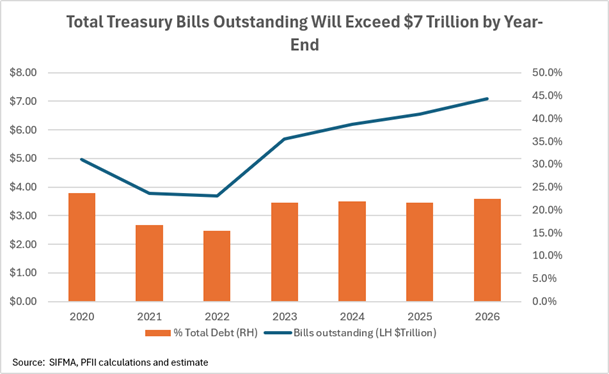
Treasury is about to flood the market with more than $400 billion of Treasury Bills in coming weeks to fill a gap in funding the federal deficit.
• This is not a surprise to those who make it their business to know such things, but nevertheless interesting as it evidences the size of the Treasury market and its dynamics.
• It will provide investment opportunities for public funds investors whose portfolios have come to rely heavily on Treasury issuance for investments. States and local governments own a total of around $1.6 trillion of Treasuries with half or more in bills and the balance in securities that mature largely within five years.
• The issuance plan also provides insights into the forces that maintain the Treasury market and support the government’s continued ability to finance the expanding federal debt load.
T Bills, T Bills, More T. Bills
Treasury’s announced plan to issue more than $400 billion in Bills in short order barely moved the market because Treasury continues to exploit a “sweet spot” where buyer appetite is strong. Buyers have been less enthusiastic about longer-maturity notes and bonds, as evidenced recently by the fact that long-term Treasury rates are now at nearly 20-year highs.
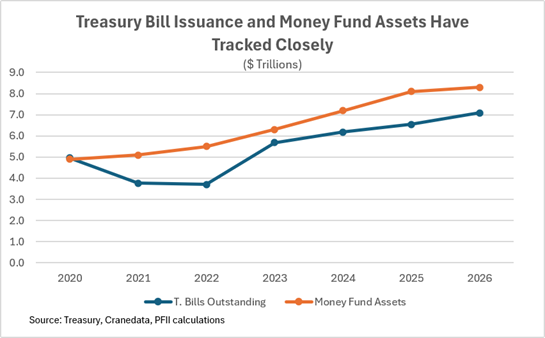
Investors have accommodated these volumes for several years because money market funds, the biggest buyers, have experienced phenomenal growth in assets and foreign buyers shifted their buying from longer-maturity securities to Bills.
A result of his issuance pattern is that bills now make up nearly 25% of total public debt. No doubt Treasury benefits from this, at least in the short run, because interest rates on Bills are much lower than they are on longer-duration notes and bonds. But Treasury also is taking on increased risk that rolling over the debt will push overall interest charges higher in the future if interest rates move up.
Treasury’s issuance plan also illustrates the tremendous liquidity that characterizes the Treasury market generally and the Bill market specifically. Overall Treasury trading volume is around $1triilion a day and the Bill market is nearly as liquid as cash. The bid/offered spread for active Bills is currently about one or two basis points, which means, for instance, the “early redemption penalty” to sell a $1 million three-month Bill is as low as $25 (plus the effect of any change in interest rates on the market value of the security at the time of sale). If you buy a three month T. Bill today with a par value of $1 million at a yield of 3.75%, rates move by 25 basis points in two months and you then go to sell it, the cost of selling, including the move in rates would be about $600, or six basis points of the value of the transaction, and your earnings rate for the two months you held the security would be about 3.70%(!). Of course, if rates were to decline by a like amount during your investment period you would realize a gain of nearly $600 that would boost your initial investment yield.
The Buyers: Money Funds, Foreign Accounts and the Fed
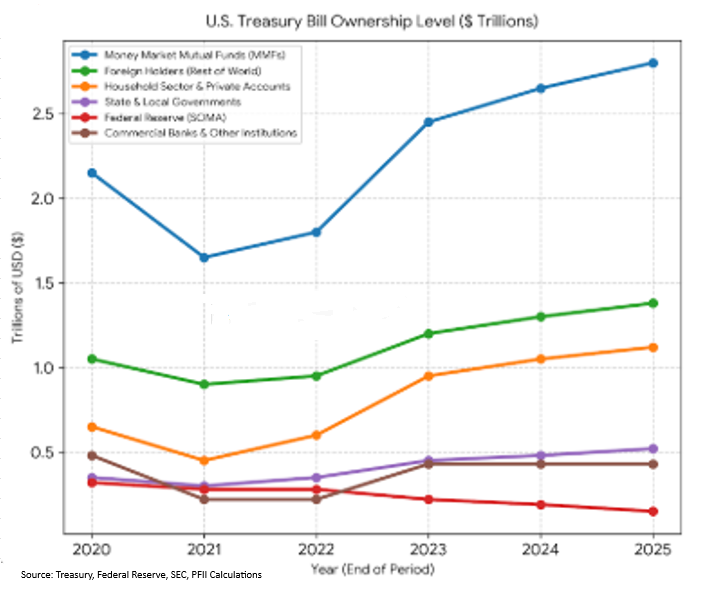
The Bill market has functioned smoothly in recent years because money funds, which own nearly half of the Bills outstanding, have experienced strong asset growth.
As long as this growth continues Treasury will find ample demand. Crypto promoters also tout the potential for stablecoin assets to grow to $1 or $2 trillion in short order, fueling demand for short-term Treasuries to support deposits.
Foreign accounts are second in the line of holders of Bills with an estimated 22%. While there is periodic speculation that foreign holders will abandon Treasuries, this seems highly unlikely. Balance of payment capital flows into dollars offset the U.S. trade deficit so foreign accounts will continue to amass dollars regardless. Once they hold dollars they will invest them in dollar denominated securities. Given the choices, even an alarmist would say that the least risky choice is a Treasury Bill. In this respect the evolving demand of foreign buyers correlates with Treasury’s issuance plans. Uncle Sam is quite solicitous of these buyers as evidenced by Treasury Secretary Bessent, a former currency trader, famously flashing a hand-written “to do” note during President Trump’s recent Camp David cabinet meeting, indicating Treasury would step in to buy $5 to $10 billion of Japanese yen to shore up value of the currency. A likely explanation: Japan might otherwise have to sell holdings of Treasuries to buy its currency, and this would not be good for the Treasury market.
Meanwhile a close analysis of foreign account investment behavior indicates a modest shift from purchases of longer maturities to Bills, perhaps out of concern for the long-term trajectory of the U.S. economy or its debt. This could be a long-term negative for the U.S. but ironically it supports the Treasury’s current strategy of increased reliance on the short-term Bill market to fund debt.
Though it owns about $4 trillion Treasuries, or more than 13% of the total outstanding, the Federal Reserve is not a major holder of Bills, with around $500 billion (less than seven percent). The Fed has expressed a desired to reduce its Treasury portfolio but is also actively buying Bills to counter market stresses in the short end of the market. It began this effort in December with purchases at a rate of $40 billion a month and is currently buying about half of this amount each month. This too supports the Treasury’s emphasis on funding the deficit in the short end of the market.
If you Are a Buyer
Treasury’s issuance is likely to cause temporary ripple in the short-term markets, pushing up Treasury bill rates modestly compared with benchmarks and also pressuring competing offerings like bank CDs and commercial paper. The effect should be modest: we estimate one to three basis points when Bills are measured against benchmarks. And it should pressure repurchase agreements a bit because some of the issuance will have to be “parked” in broker accounts for a time by using repurchase agreement transactions to finance them.
Supply and extraordinary liquidity make Bills a strong contender for treasurers and investment managers seeking fixed rate investments to match operating cash flow requirements.