Whatever it Takes. The Warsh FOMC
Kevin Warsh’s news conference at the conclusion of the Federal Open Market Committee meeting on Wednesday revealed two things:
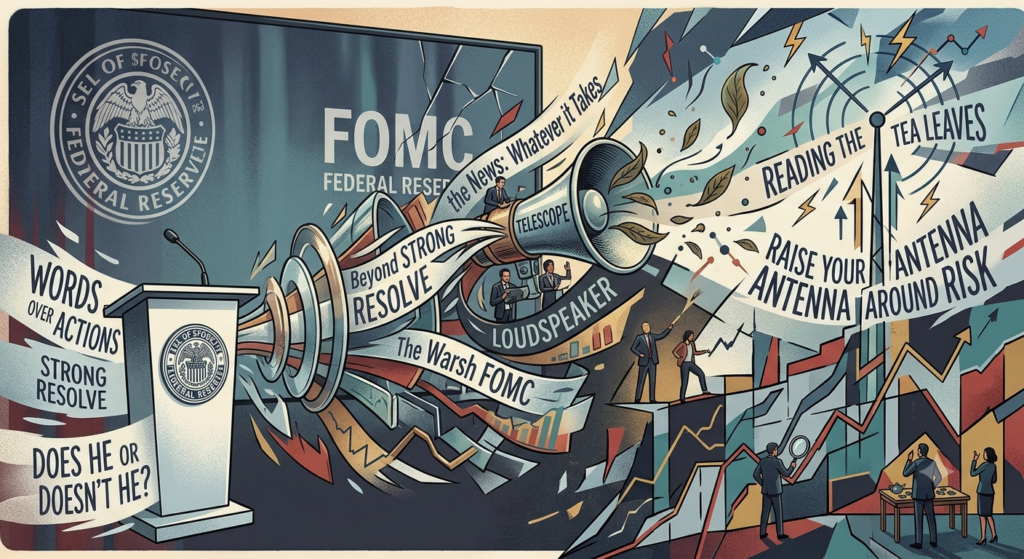
- Warsh may say he’s abandoned the Fed’s “forward guidance” approach to monetary policy but in reality, he seems to have doubled down on the application of words, rather than actions, to steer the economy. Rather than acting to raise rates Warsh spoke of strong resolve.
- The chair is also going to lean in to the idea that markets can play a major role in setting interest rates—that they can self-correct. Better to refresh on reading the tea leaves and raise your antenna around risk.
These two principles, that guidance matters and markets can self-correct, have a history that was tested during the Great Recession of 2008, when Warsh was the right-hand to then Fed chair Ben Bernanke. Then the Fed’s initial approach–urging calm, expressing resolve to do whatever it takes and organizing market forces to steady things—was not enough. The fall of the economy into near depression was reversed only when the Fed, Congress and the Bush and Obama administrations found ways to inject trillions of dollars into controlling the damage and supporting the financial system.
The History
The Fed’s formal use of forward guidance was rolled out in the early 2000s but moved to center stage in December 2008 after the central bank had reduced rates to zero and sought other means to stop the economic freefall. In the common vernacular, with a statement after the December 2008 FOMC meeting the Fed was saying “we’re going to keep rates at zero for some time. You can (should) bank on it.”
As he laid out the guidance in 2008, Bernanke, with Warsh at his side as a Fed governor, also touted the central bank’s other tools. Quantitative easing was the most notable one, but the central bank and Treasury ultimately implemented a slew of unprecedented strategies to support banks, money market mutual funds, the commercial paper market and the federal housing agencies. David Wessel characterizes this, in his book, In FED We Trust: Ben Barnanke’s War on the Great Panic, as doing “whatever it takes.”
Watching Warsh, I couldn’t help but think back to 2008. In important ways Warsh 2026 sounded like Bernanke/Warsh in 2008. Not that we’re in a financial crisis, but the absence of Fed action Wednesday leaves investors to rely on the strength of words from the Fed chair about resolve to bring inflation down. How? By using all the tools at the central bank’s disposal.
Markets are Skeptical
If investors believed in the success of this approach, they would bid up bond prices, pushing interest rates down based on the expectation for lower future inflation. In reality they have done the opposite. While the federal funds rate remains at the 3.50%-3.75% level set in December, two-year Treasury rates have risen from their early spring lows by nearly one full percent. The rise is across the yield curve where 30-year Treasurers recently reached a level not seen since 2007.
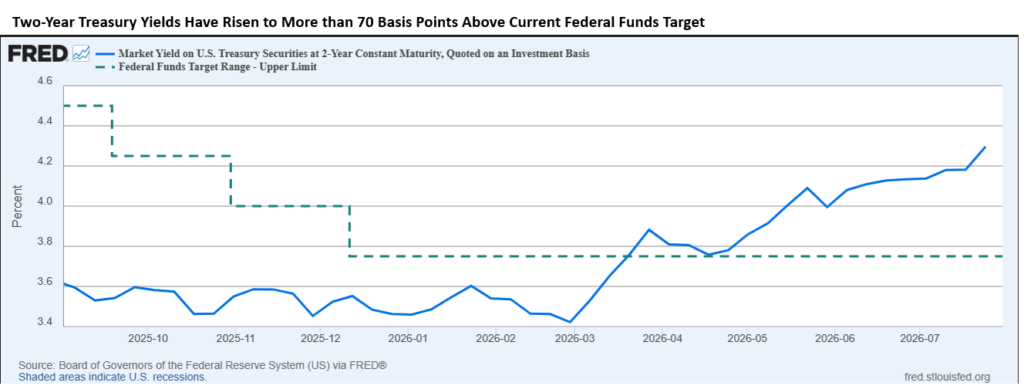
Investors are demanding a greater premium on the chances that rates will be lower in coming months/years. In the spring the interest rate futures markets were priced for a federal funds rate of 3.0% or so one year out and two-year Treasuries had a yield that was below the current federal funds target. Today investing in the two-year Treasury will pay you about 70 basis points more than the current federal funds rate.
That move points strongly to higher, not lower, short-term rates in coming months. Faith in the Fed should result in an inverted yield curve, yet we’ve seen the opposite evolve in recent weeks.
Forward Guidance in a New Coat?
Warsh may be trying to pull back from forward guidance, but it seems he’s not ready to abandon it. Wednesday he described “offering forward guidance with clarity” when in crisis but reserving during benign times. Meanwhile he was forceful in stating the Fed’s resolve to bring inflation down to two percent. But there was no action by the committee. It voted 9 to 3 to maintain the policy rate and its ample reserve policy. Not to nitpick, but in the Powell era the Fed might have said something like “the balance of risks leads us to maintain current policy.” In the Warsh era it’s something like “trust us, we’re going to beat inflation.” Is there a difference?
The Self-Correcting Market
There is little doubt that markets are self-correcting, but this is not without consequences, often consequences that have tilted in favor of prudential regulation.
In 2008 self-correction led to a frozen market—investors not sure of value moved to the sideline—and huge risk premiums for taking on credit risk. All of that made good economic sense, but the consequences, on jobs, incomes and social well-being became unbearable so policy makers were forced to act.
We could well test this tension again in coming months.