LGIP Disclosure and Transparency: An Opportunity Lost?
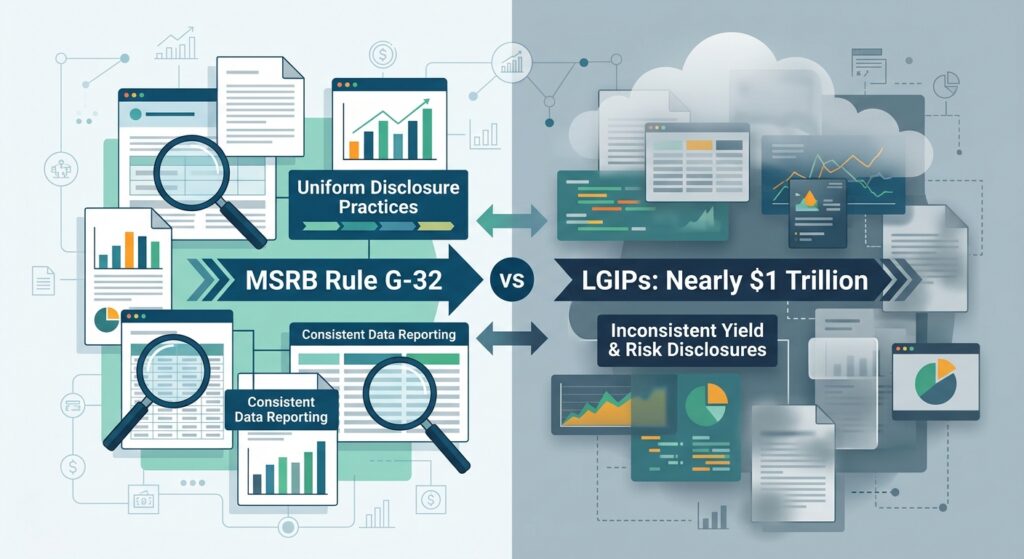
A lost opportunity to improve disclosure and transparency around local government investment pools. That’s the likely outcome of an effort by a regulatory agency, the Municipal Securities Rulemaking Board, to modernize disclosure for municipal fund securities, a class that includes LGIPs and state-sponsored 529 plans.
From the Top
- LGIPs and 529 plans share common characteristics: They are collective investment vehicles operated by governments. They are generally outside of the purview of federal securities laws but one area where they are not is disclosure/fair dealing by agents who they employ to market their offerings. These agents are subject to rules of the MSRB. (This is not legal advice. Anti-fraud laws have been applied to states and localities that issue securities.)
- In 2024 the board began an effort to modernize its disclosure rules, opening the way to providing common disclosure/transparency principles to the growing LGIP industry.
- LGIP marketing agents have largely ignored the MSRB’s rules, and they gave this initiative a collective shrug. The board’s reaction was to scale back its effort, ignoring suggestions from the Government Finance Officers Association on how to improve disclosure for the thousands of LGIP investors.
LGIPs and 529 Plans: Common Rules But Different Results
LGIPs and 529 plans are both built around the idea that government entities operate plans to provide for collective investment of assets. Under federal law the sponsors of these plans, state treasurers and trusts that form LGIPs, are viewed as instrumentalities of states (or localities) providing an essential government service. This exempts them from many of the rules that federal securities laws place on collective investment vehicles like mutual funds. They are free to organize and provide services as they please notwithstanding that they are in an industry that is highly regulated.
One exception applies: under federal law their marketing/distribution is subject to the rules of the MSRB. The MSRB doesn’t regulate issuers, so their rules do not apply to state treasurers who sponsor plans or LGIPs or to local-sponsored LGIPs themselves, but they apply to those who distribute the shares in their investments (unless they are government employees). They must be registered and follow rules designed to provide for full disclosure, fair dealing, and investor protection.
The MSRB rules cover what can or should be said about the investment offered—in the LGIP world this is generally contained in an information statement or investment policy document—that explains its nature, risks, costs, and how to purchase/redeem. They also cover ongoing disclosure of current information because some of the facts related to the security may change each time an investment is made—yield, portfolio characteristics and asset flows are examples.
The MSRB rules seek to create a transparent market for 529 plans and LGIPs, but the plans and LGIPs have responded to the MSRB rules very differently. In a few words, the 529 plans have embraced the MSRB’s efforts while LGIPs have largely ignored them.
For example, MSRB rules require that offering documents for 529 plans and LGIPs marketed by agents be filed with the board, and they have created a separate web presence to provide access to this information by 529 plan participants and the general public. All 49 states that have plans appear on the website. State-sponsored LGIPs that use their own employees to market are exempt from the MSRB rules but those that employ outside agents to market and local-sponsored pools that do not have employees would appear to be required to file offering documents with the MSRB. Together that is more than 70, entities, but based on a review of MSRB filings only 16, all of whom employ the same marketing agent, have filings with the MSRB. (To be clear the obligation to follow the rules is on the agent, not the state treasurer or board of an LGIP.)
MSRB Scales Back Initiative to Improve Disclosure
In 2024 the MSRB began an effort to improve transparency and disclosure of key information such as risk and performance for the programs and asked interested parties to provide suggestions and information. The board asked whether to streamline the delivery of disclosure information by using electronic vs. paper delivery and the 529 plans were enthusiastic in their support.
The concept release announcing the initiative also asked about improving disclosure of vital “time of trade” information such as investment yields. The advocacy group for the 529 plans responded by expanding its Statement of Voluntary Disclosure Principles, a description of best practices that would provide its investors with information on the nature, risks, performance, and costs of its offerings. When the MSRB issued a formal notice last month that it would revise the rule on delivery of marketing documents it cited the Voluntary Disclosure Principals as a reason why it need not delve into time of trade disclosure details.
The MSRB’s 2024 concept release sought specific examples of information that might be material to LGIP investors. In response the Government Finance Officers Association commented that it welcomed this step to look at disclosure rules and offered detailed suggestions of items that should be included. These include many of the characteristics that are required of money market mutual funds but are not uniformly available for LGIPs.
The GFOA comment could have given the MSRB reason to develop guidance around fair dealing and disclosure by LGIP agents. Or it could have encouraged LGIPs to develop voluntary disclosure principles, as did the 529 plan sponsors. But this has not happened. Instead, in a September notice of proposed changes to its rules, the MSRB scaled back its initiative, limiting the changes to streamlining information delivery to investors. Why no guidance on bolstering disclosure and transparency for the LGIP investors? The board cited the idea, pedaled by the securities industry, that localities are sophisticated and employ financial professionals who don’t need the kinds of uniform disclosures about their investments that benefit other investors.
This is an unfortunate outcome, though perhaps not unexpected given the fervor with which Washington is running away from regulation these days.
Meanwhile a few LGIPs, managed by companies like Federated or Fidelity, do provide the kind of highly transparent and uniform disclosures that are available for mutual funds. Perhaps it’ s because they apply the mutual fund model to their LGP clients. But for the most part LGIP investors, who have nearly $1 trillion invested in the pools, are left to sort through a mix of inconsistent information on performance and risk when they make investment decisions.
Requiring a uniform level of transparency should be a no brainer. The GFOA’s comment letter to MSRB is an invitation to develop standards that would meet the needs of public sector in investors. Whether the MSRB steps up to the challenge remains to be seen.
——-
You can read the MSRB’s September 2026 notice and file comments through December 14 here. The GFOA comment letter is here. The MSRB’s 2024 concept release is here.