30 Year Treasury in the News: Why it Matters to Short Term Investors
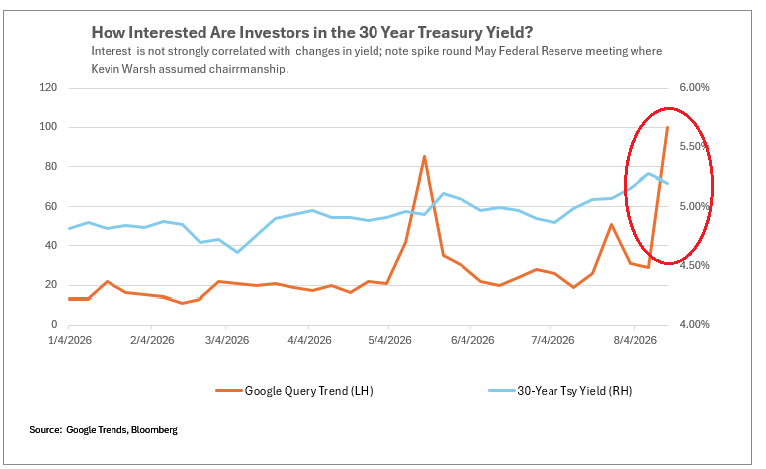
I’ve been watching the yield on the 30-year Treasury closely for the last several weeks even though my main focus is on short-term markets. That’s because it is sending important signals about changing market conditions that will affect those who invest in cash vehicles, bank deposits and short-term securities whose investment horizon is no longer than a few years. The accompanying chart tells an interesting story: recent heightened interest in long term Treasury yields does not seem to be related to changes in the yield of the bond. It has moved only modestly in recent weeks.
- The yield on the long-term benchmark has been the highest in nearly 20 years, but this is not supported by underlying economic conditions: modest growth, a low unemployment rate accompanied by a modest expansion of employment opportunities. Inflation, while elevated at around 3.5%, is below levels of 2021-2023, and while it may not fall easily to the Federal Reserve’s two percent target, few expect a sharp acceleration.
- Nor does the yield on the 30-year Treasury seem due to a sudden change in the outlook for the course of the federal deficit or the pace of funding it with long-term bonds. Yes, crossing the mark of $40 trillion in public debt was notable, but also quite predictable. For anyone who cares—and one would think investors in 30-year debt are among them—the debt trajectory has been obvious for some time.
- Don’t blame near-term monetary policy either. Sure, there’s a new Federal Reserve chair, but the central bank’s policy rate has been at 3.50%-3.75% since last December. No mainstream market economists have a forecast that doesn’t see a contained likelihood for a burst up. No five percenters here.
Elevated 30-year Yield Signals Change in Fundamental Market Dynamics
There are three factors that have pushed long-term yields to these levels. They all relate to uncertainty and lead investors to respond to market psychology—rather than to the efficient markets thesis that yields and prices are largely data-driven.
Start with our obsession with artificial intelligence, perhaps fully justified, perhaps not. It dominates visions of the future but how and with what force it will change our lives, our economy and our markets is uncertain. Maybe we’ll enjoy a period of unprecedented growth, problem solving and economic satisfaction or maybe a period of dystopian disruption. Until there is clarity of vision all markets will be under the influence of this heightened uncertainty.
Overlay this with the efforts of the Trump administration to manage the markets. This has been in the background for some months with Trump calling for one percent short term interest rates whether or not traditional mainstream economics would justify rates at that level. But the intervention of the U.S. in the Japanese currency market last month and last week’s announcement by Treasury Secretary Bessent that the Treasury would become active in buying back outstanding Treasury debt to push down rates puts this on the main stage.
Attempts by government to manage the markets by intervening do not go well. George Soros demonstrated this in 1992 when he bet against the Bank of England’s effort to manage its currency. Bessent, who joined Soros Fund Management in 1991, seems to have forgotten this despite a reminder recently from Stanley Druckenmiller, Soros’ chief strategist and a former employer and mentor, who went on to a successful effort to build his own financial empire. Druckenmiller warned Bessent that such efforts are doomed to fail.
Then there is the clear effort by the Treasury and newly installed Fed chair to pull back from a policy of transparency and predictability. Forward guidance is out at the Fed. “Let the market lead,” so to speak. Never mind that when Warsh was Fed governor in 2006-2011, he was the right-hand to Ben Bernanke who is largely credited with implementing central bank guidance to seek to reduce market volatility.
But Treasury seems to be saying the opposite. Last week, in announcing an expansion of the Treasury’s program to buy back its own bonds Bessent seemed to be saying the investors had taken the wrong signals from the markets so Treasury would intervene directly to guide them by seeking to push long rates down through its purchases.
The timing of this announcement was troubling because it came two weeks after the quarterly meeting of tew Treasury Borrowing Advisory Committee, a panel that represents the largest market making firms and provides advice to Treasury on its borrowing needs. Treasury and TBAC supported a plan to maintain the pre-existing buy-back program, sized to support liquidity but not to “manage” rates. The plan endorsed new issuances of intermediate and long-term debt for the remainder of the year at levels that have been unchanged in recent quarters. Hard to buy and distribute trillion of dollars of Treasury debt when the issuer reserves the ability to changes its mind/intervene in the markets on a moment’s notice.
What to Expect
Treasury and the Fed will be more active in the short-term markets. Treasury signals that it will increase reliance on Treasury bill issuance to fund the deficit and that it could become more active in managing its cash position and changing borrowing for them in the short-term markets. This would mean that that bill supply will increase on a less predictable pattern.
This is unlikely to disrupt the market—it is deep and liquid—but it will create more opportunities for investors.
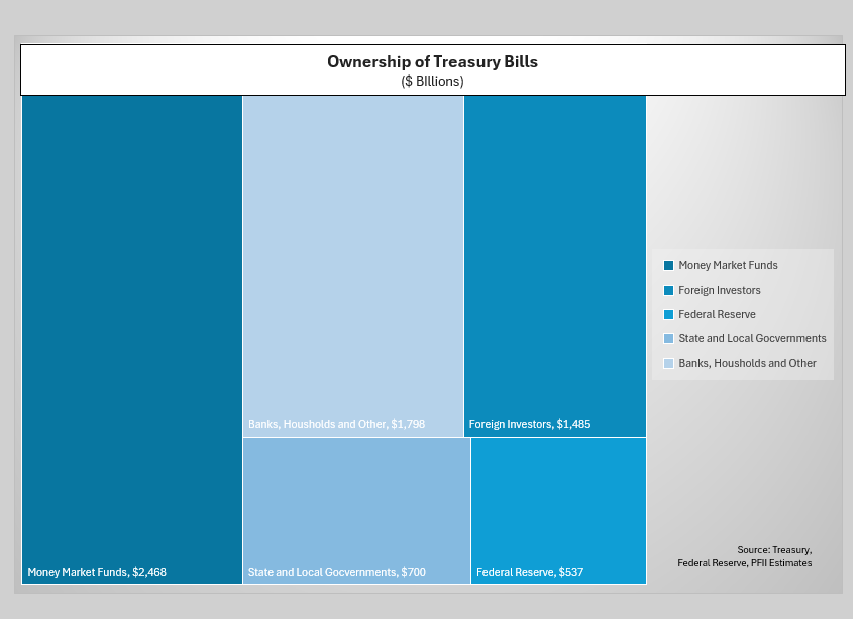
Nearly forty percent of bills are owned by money market mutual funds, whose assets are up 50% in recent years. About 20% are owned by foreign investors. (See our Beyond the News post, A Deluge of T. Bills.) As long as money funds grow or are maintained and the trade balance requires an inflow of dollars, demand for bills will persist.
And if not? Well, the Fed will step in and print money to buy bills. It has done this from time to time and, when it began buying in December to stem a bump in financing markets volatility, it demonstrated that it will continue to stand by the markets, no matter what. (That’s not to ignore the potential inflationary effects of the Fed printing money, but that is an entirely different matter.)
Other borrowers will pay up for market access. In the short-term markets, issuers of commercial paper and bank deposits are likely to pay a bit more to raise money. Don’t expect a big jump in rates when compared with Treasury (or swap) benchmarks but if you’re a corporate or bank treasurer, you’ll be inclined to offer a few more basis points to secure your funding.
The market will become less predictable. Data, like employment trends, inflation measures, growth and funds flows are closely studied by investors who seek to build strategies around efficient market theories—that markets respond efficiently to this type of information.
A second force is also at work. Call it impulse, market psychology or whatever. The Dutch tulip bubble in the 17thh century is a classic example. The GameStop stock trading frenzy in 2021 is a more recent one. Unexpected announcements, unsigned policy shifts and rumors and prediction site betting will become more important drivers.
Memes could move the market!
_________
This post was revised after initial publication to better highlight that the recent uptick in Google trend interest in the 30-year Treasury yield does not seem correlated to a big move in the yield. The yield on the long bond has been contained to a small range in recent weeks.