FOMC Meeting: Expected Result, Cloudy Future
In the run-up to the just-concluded Federal Open Market Committee meeting I penciled three questions. Here they are with brief answers:
- What would the committee do? No surprises. A 25-basis point hike. A unanimous vote.
- What would Warsh say? Not much.
- How would the market react? Not positive.
It’s not a very satisfying result and one which leaves the path of interest rates over coming months highly uncertain.
Market Inflection Points
The Fed has been careful—some would say too careful—about signaling changes in policy and developing a case for the change. That’s what Fedspeak is supposed to do and forward guidance, a concept developed by former Fed Chair Alan Greenspan, is part of this communication. “Send signals about what we’re going to do and why and investors can respond in an orderly way by making appropriate adjustments to their market behavior” is the idea.
To illustrate, we tracked the performance of the two-year Treasury as a leading indicator of Fed action at the last six inflection points (2015 through 2026 excluding the Covid-19 move). As the following chart shows, in the 30 days before each change 2-year Treasuries led the way—one might say they successfully anticipated the result. They moved lower in advance of a cut and higher in advance of a hike.
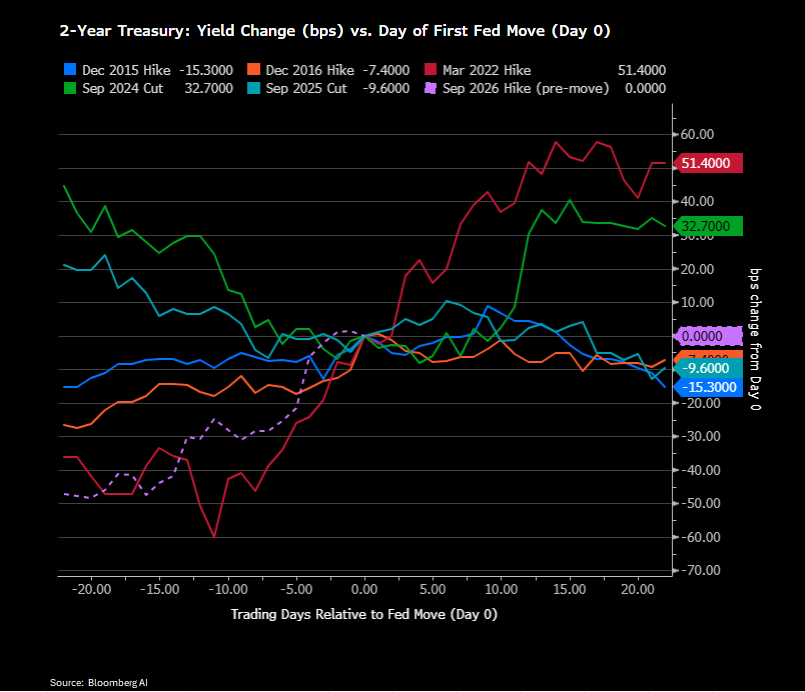
In the 30 days after a change, they also generally led the way. The 2015, 2016 and 2025 moves were first steps in a modest change, and the market moves in the 30 days following the cut were modest. The 2022 hike was the first step in a big move that would raise rates from zero to 5.50% in short order and two-year Treasury responded by rising 60 basis points after the hike. That’s likely a result that the central bankers wished to achieve.
The 2024 cut illustrates what happens when communication breaks down. Two-year Treasury yields fell by 25 basis points in the days before the cut, the Fed surprised by cutting 50 basis points without clear signals, and two-year rates subsequently rose by 39 basis points.
Why Now?
It’s not clear why the Fed acted now to raise rates and what might motivate the committee’s future actions. Warsh at his presser characterized the economy as “resilient” the job market as “in good shape” and inflation as “above target” but not accelerating. Not very different than the characterization used by Warsh, by former chair Jerome Powell, and by many of the individual members of the FOMC in recent months.
Economists poring over volumes of data looking for changes in the direction or pace of the economy find that little has changed in the reported economic measures over the past three months. Everyone has their favorite measures of economy activity, and one can find a measure to fit almost any conclusion, but as the following table summarizes, the trends that Warsh called into focus are the same now as they were at the time of the July FOMC meeting. Yet a committee that voted 9-3 to keep rates unchanged in July voted unanimously to raise them at this week’s meeting.
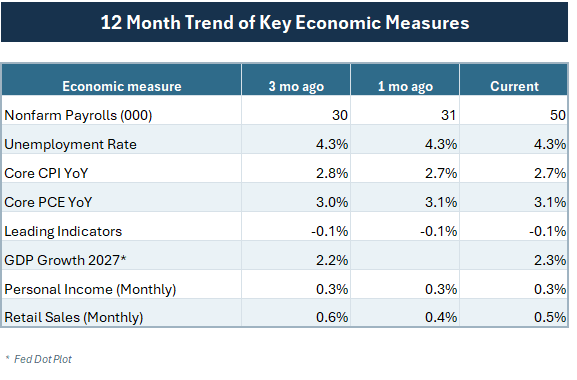
It’s possible that the July FOMMC meeting was a “give peace a chance” moment. And since the inflation trend did not improve the committee decided to try to nudge it lower.
Problem is that one or two rate increases—most analysts see only one more in the immediate future—are unlikely to depress global price increases. At this pace either they will work their way through the economy, and the rate inflation increase will abate or not.
A Market Without Forward Guidance
Warsh has been firm that he does not think the central bank should offer forward guidance. But communicating intentions, not just in broad terms such as “we will control inflation” but in terms that investors can interpret and validate is a fundamental tool of monetary policy. That communication has weakened and markets have become somewhat disconnected from the Fed. One indication is the rise in long term Treasury yields. (I posted about this last month). They remain near 20-year highs following the FOMC meeting. There are many theories to explain this, and it would not be fair to point to monetary policy as the main reason, but lack of clarity doesn’t help matters.
Meanwhile, What Does it mean for Short-Term Investors?
The course of LGIP and other cash investment rates over near-term course seems clear. The following chart shows a path over the next six weeks or so when the FOMC next meets. The forecast for LGIP rates is based on our model LGIP portfolio.
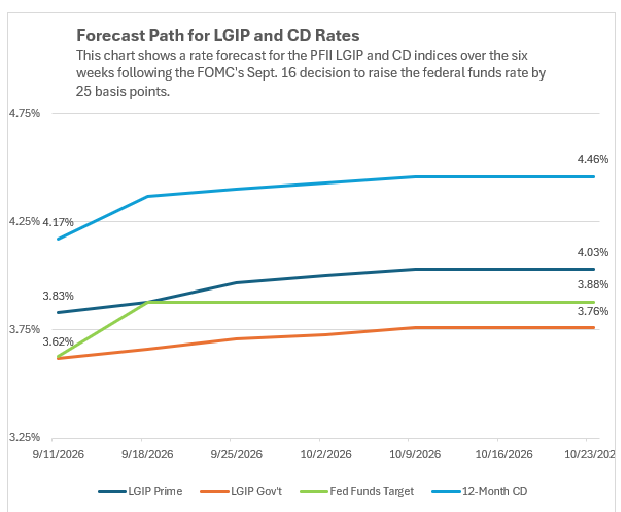
Stable value LGIP portfolios came into the FOMC meeting with average maturities in the 35-to-45-day range. This means that it will take them a few weeks until their portfolios fully reflect the higher overnight rates. The yields they quote, derived from income over the prior seven days, will also lag the daily rate.
They will gradually move 20-25 basis points higher than they were last Friday. CD, commercial paper, and other cash rates will respond much more quickly. We expect our CD Index to show rates for 12-month collateralized deposits in the 4.40% to 4.50% range immediately. Cash investments like commercial paper (30-day offerings are at about 4.15% at this writing) and short-term Treasury bills (one month at about 3.80%) have already adjusted by the full margin of the federal funds change. Investments offered by term portfolios should also adjust higher immediately.
Rates on two- and five-year Treasuries are in the range of 4.70% to 4.90%, nearly 100 basis points over the new target federal funds rate. Those are the widest margins since the Fed pushed the overnight rate up to 5.50% in the post-Covid-19 months. They could be a steal. Or they could be influenced by a lack of clarity on the all important question of “How high? How long?”
____
This version is updated from the original to correct data n the table 12 Month Trend of Key Economic Measures.