Halftime: What’s in Store for the Balance of 2026?
Last week’s Crane Money Fund Symposium brought together portfolio managers who invest assets in the $8 trillion money market fund industry along with those who invest portfolios for the major banks. It’s a small number of people whose views on the economy and investment markets are incredibly important in setting the course for short-term interest rates. The symposium came on the heels of the first Federal Open Market Committee meeting chaired by Kevin Warsh which seemed to mark the beginning of a new direction for monetary policy. The timing and the audience provided an opportunity to consider the path of the short-term fixed income market for the balance of 2026.
With that in mind here are key themes that came out of the meeting:
The Fed Will Raise Rates
The consensus of portfolio managers seemed to be for one or two 25 basis point increases in the Federal Reserve’s target rate (currently 3.50%-3.75%) over the balance of 2026. Bank and broker economists at the symposium, many of whom are regularly on Bloomberg, CNBC and on investor roadshows had a wider dispersion of views, from forecasts of unchanged rates to those who foresee three increases. Portfolio managers leaned toward the mild side. One or two increases would be a big change from the outlook early in 2026, when federal funds futures contracts predicted an overnight rate of 3% or less by year-end, but persistent inflation and a slow but positive expansion of economic activity have led to the adjustment.
We’re Going to Have to learn a New Dialect of Fedspeak
Forward guidance is gone and the trend toward transparency will seemingly be replaced with an effort to keep monetary policy options open. The dot plot and Summary of Economic Projections that we came to rely on in the aftermath of the Great Recession may soon be retired. Investors will search for new signs of Fed intentions. Without these elements of policy participants at the symposium seemed strongly of the view that market volatility would increase, though that’s certainly not the intent of the new chair.
A Surge in Treasury Bill Supply Will Dominate the Second Half of 2026
Treasury is expected to issue $800 billion(!) of bills over the next six months to fund the federal deficit. It will increase outstanding bill supply by about 12%. This may seem like a striking figure, but it’s in line with issuance last year. If you are a buyer/investor more supply is a positive as it should put modest upward pressure on yields.
Market participants expect that money funds will continue to absorb much of the supply with their assets extending the pace of recent growth. Bill issuance over the past several years has been matched by growth in money fund assets.
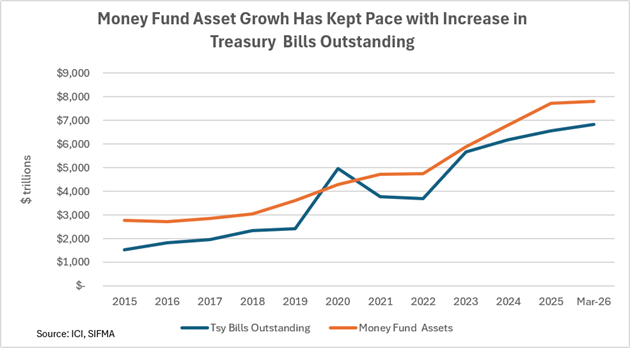
As long as these trends continue markets should remain calm.
If not, there is always the Fed which currently holds about $4.5 trillion of Treasuries. While Warsh has indicated a desire to reduce the central bank’s presence in the market, the outlook of portfolio managers is that this effort will not be implemented to any scale in the short run. Indeed, the FOMC reiterated its commitment to maintain ample reserves in the banking system (plain language translation: “if need be, we’ll step in and buy bills”)
The Prospect of More Bills Could Put Modest Upward Pressure on Money Market Yields
Bank deposit rates and commercial paper rates could rise to add spread to comparable bill rates. Financial institutions will want to assure funding in the face of the bill onslaught and also position for the end of the year when funding normally gets more challenging.
Some evidence of spread widening already has shown up in levels posted by banks for maturities of six months or more, and this spread widening could continue in coming weeks.
Central Clearing of Repo Will be a Big Focus
For those entities that invest through repurchase agreements and are subject to mandatory central clearing, adjusting to cleared repo before the deadline a year from now is a significant focus. The overall repo market at $12-13 trillion is about the same size as the cash market. Observers believe that once central clearing becomes the rule those who do repo outside of the framework will have less liquidity and receive rates lower by one to three basis points. State and local government investors are exempt from central clearing rules and with few exceptions make less use of repo than money market funds and other institutional investors. Nonetheless, adapting to the changes could provide opportunities for improving interest income not currently available.
New investment Vehicles Provide Buzz but Little Substance to the Markets
Market participants are buzzing about stable coins, tokenized money fund shares and money fund ETFs but these innovations remain on the fringe. Either the technologies are still in formation, or the business case is lacking, and they are not seen as impacting the markets, at least in the short run.
Meanwhile Markets Have Coalesced Around Milder High, Slower Pace
Two weeks after Warsh chaired his first FOMC meeting markets have settled on a consensus for rates—they will move higher but the high will be milder and the pace slower than in the pre-meeting market outlook. To Illustrate this. the accompanying chart compares short-term interest rates the week before the Fed meeting, (June 12) the week immediately after (June 19) and last week.
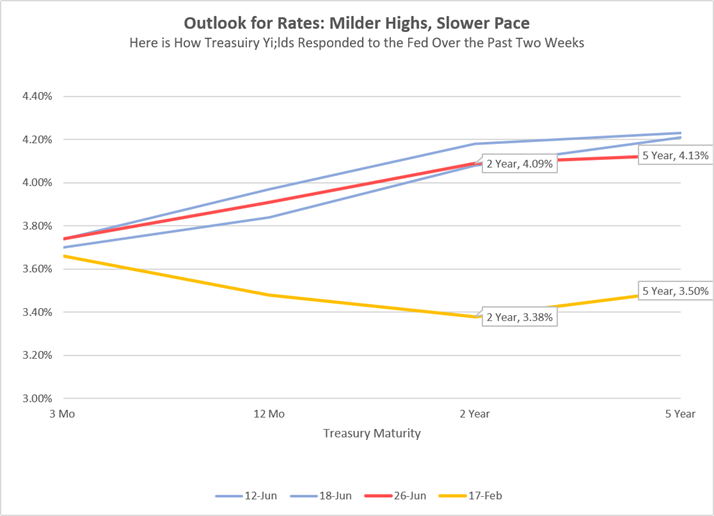
After the June 17 meeting two-year Treasury yields reached nearly 4.20% and five year yields reached nearly 4.25%. By last week the climb had stopped and in fact reversed a bit with the yields at the end of the week down by about five basis points.
Expectations for modestly higher rates also are reflected in the weighted average maturities of money market funds. The average WAM of funds tracked by Crane was 39 days at the end of June, not very different than over the past several months. This is consistent with expecting modest changes in rates.