LGIPs Seek New Markets
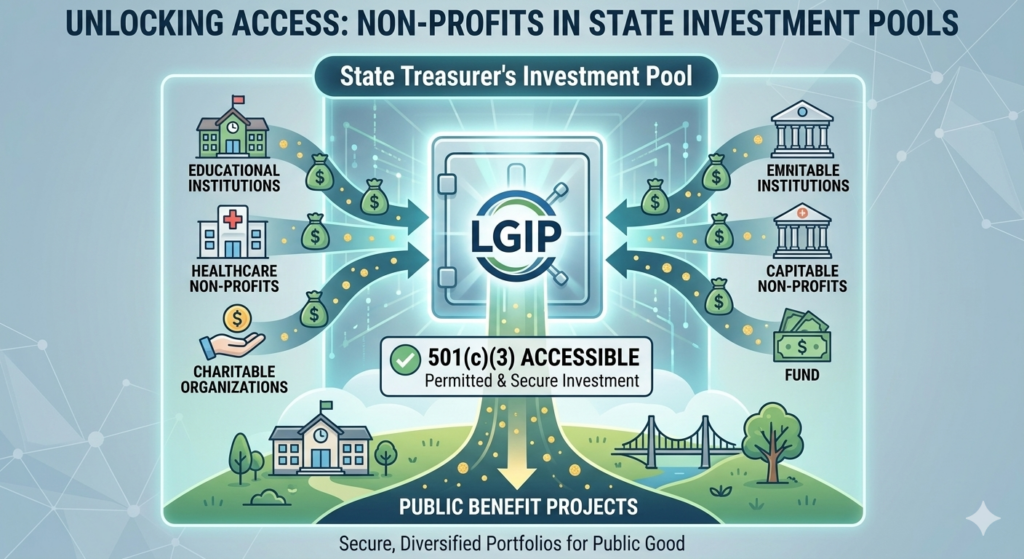
Local Government Investment Pools were originally designed to help local governments—you know, cities, counties, school districts, etc.—invest their funds. But times change and enterprising funds seek opportunities to expand their offerings. An interesting example is a new program that the Illinois Treasurer is poised to open for Illinois-based non-profits.
- The new portfolio will be an addition to the $20 billion Illinois Funds pool managed by the Treasurer. It relies on recently enacted legislation for standing.
- The offering will build on the notion that these entities that provide services akin to those provided by governments should get assistance.
- While the main focus of the LGIP industry is governments, narrowly defined, Massachusetts and Pennsylvania, have LGIP programs that are designed specifically to manage funds for non-profits.
- Some LGIPs also have accommodated organizations that might not seem to be governments but perform activities that are expected of governments. These LGIPs accept investments from entities that offer health services, education, library services, etc.
- Some LGIPs also have accepted investments from non-profits that operate as direct extensions of governments with their boards controlled entirely by a government entity.
Illinois Funds Non-Profit Investment Pool
Illinois Treasurer Michael Frerichs worked with the Illinois legislature for several years to gain authority to create the new pool. The result, Senate Bill 2968, authorizes creation of the Non-Profit Investment Pool to accept investments from Illinois-based non-profits that provide healthcare, education, affordable housing, food assistance, environmental protection, cultural arts, job training, services to seniors and similar services.
The limited focus excludes private foundations, political organizations and organizations that are not domiciled in the state.
The legislation does not specify that the new pool be a constant net asset vehicle, but it seems likely that it will be. Advocates pointed to the Illinois Fund, which operates substantively as a money market fund, as an example of what they would offer.
Programs in Other States
Massachusetts and Pennsylvania are two states that have LGIPs that reach beyond the narrow definition of “government.” The Massachusetts STAR Fund, offered by the Massachusetts Development Finance Agency since the 1990s, accepts investment from non-profits that are borrowers through the Agency’s borrowing programs. It is designed to manage bond proceeds in a manner that supports compliance with the arbitrage rebate requirements of the Internal Revenue Code and had about $350 million of assets in its constant net asset value portfolio as of Deceber31, 2025. The program is managed by PFM Asset Management/U.S. Bancorp Asset Management. It is separate from the Massachusetts Municipal Depository Trust, one of the nation’s early LGIPs.
The Pennsylvania Treasurer has offered a Community Pool as part of its state LGIP program (InvestPA) for a number of years. Recent information shows assets are just shy of $100 million. It is offered to non-profit entities that are charities, foundations, social welfare organizations, and professional and trade organizations located in Pennsylvania. These may include charter schools. It is separate from the Invest PA Daily Pool that is offered to local governments. Both are managed by Federated Hermes.
Some LGIPs accept investment from entities that may not be, by a narrow definition, thought of as governments. For example, the California Local Agency Investment Fund accepts investments from non-profits that are entirely controlled by a local government and provide government-like services. A number of LGIPs accept investments from non-profits like libraries, charter schools, and police organizations, which are organized as non-profits.
Money Funds by Another Name?
LGIPs have a big operating advantage because they are mutual funds that operate outside of the strict limits of the Investment Company Act of 1940 and rules, including Rule 2a-7, that strictly limit portfolio maturity, asset quality, and liquidity. They do so under a part of the Investment Company Act of 1940 that excludes states and political subdivisions from being defined as an investment company.
Without the flexibility that the exemption offers the LGIPs would be just another money market fund, jostling in a basket and competing with hundreds of managers that manage more than $8 trillion in assets.
To demonstrate that their LGIPs are eligible for this exemption, states have relied on the fact that their LGIPs are operated by state Treasurers. Local-sponsored LGIPs have generally restricted membership of their boards, some requiring that all board members be full-time government employees, and others requiring that a majority have this qualification. Some local-sponsored LGIPs also rely on the fact that they operate under a specific state law as evidence that they serve an essential government purpose.
The LGIPs also limit investors to those that are a government or closely tied to government. Whether that is a requirement that is essential to maintaining exemption and exactly where the line should be drawn are not entirely clear. The SEC, which enforces the rules, has not said. And the Municipal Securities Rulemaking Board, which considers shares of LGIPs to be Municipal Fund Securities under its authority, has been all but absent from the details of defining securities activities that might fall within its rules.
LGIPs have approached this third rail with great caution. States and their treasurers are on strong grounds here and a state law that specifically authorizes a fund for non-profits within a state would seem to provider a strong basis for avoiding the claim that the LGIPs program is operating as a money market fund by another name.
Extending eligibility to invest, especially for LGIPs that are local-sponsored and/or operate without specific statutory authority, seems a bit like frontiering. Reminds me of skiing out of bounds. Perfectly fun until it isn’t.