Banks Have Changed Their Business Model and Public Funds Investors Are Implicated

There was a time when banks seemed to dominate the public funds investment world. For the thousands of small and mid-sized local governments they were the go-to source of investment income. When a city, town or school district had money to invest, they sought bids from banks, placed the funds with the one offering the highest (collateralized?) level and were done.
But the world has changed and bank deposit accounts have become less prominent as an investment vehicle for public units. Why is an intriguing tale.
- The banking business is increasingly dominated by the largest global institutions who have access to the wholesale funding market where they can issue commercial paper and negotiable certificates of deposit. They have gained market presence in the last five years.
- Banks have rearranged their public funds business, promoting transaction accounts that pay no interest and competing aggressively less for interest-paying accounts.
- Rates offered by banks for deposits have been no bargain in recent years. We began tracking these rates systematically two years ago and compile weekly indices of collateralized CD levels for three- six-and 12-month deposits. Over this period banks have consistently offered rates that are only slightly higher than rates on Treasury bills. They are generally lower than levels offered by commercial paper, negotiable deposit instruments, and prime local government investment pools.
- With banks offering less competitive rates LGIPs have reduced holdings of bank deposits. Our 2025 survey of LGIPs showed they held lower levels of bank deposits at the end of 2025 compared with a year earlier, likely because portfolio managers found greater value in other investment instruments.
- Meanwhile community bankers have sought legislation in a number of states to limit the competition of LGIPs. This strategy is seen as an alternative to the strategy of boosting offering rates to compete with the pools. The legislative effort so far has not been successful.
Deep Dive
The nation’s 10,000 or so depository institutions raise deposits from a variety of customers including households, corporations, intermediaries like money market mutual funds and state and local governments. The bank business has expanded rapidly in the past five years (ending March 31) with total bank deposits up from $16.7 to $19.0 trillion. The largest (the Global Systemically Important Banks) also grew their market presence at the expense of community banks to the point where they now account for nearly half of all deposits.
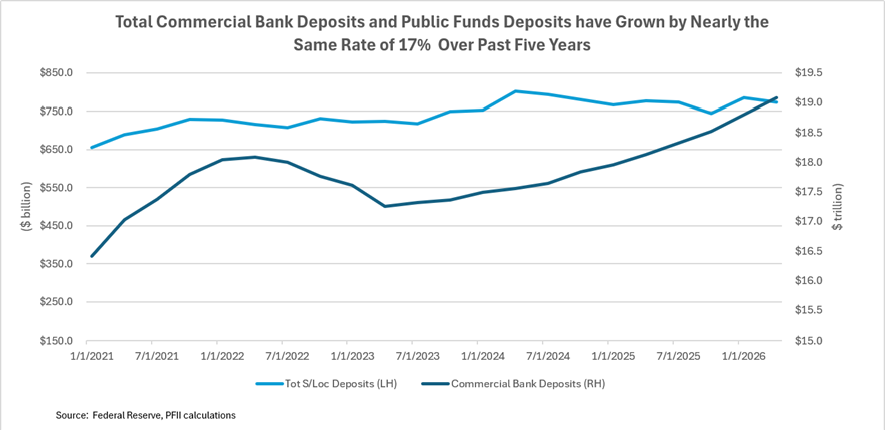
As tax revenue and federal aid programs expanded, swelling state and local government investment portfolios, their total holdings of bank deposits grew but at a slower pace than the overall rate of increase of investment assets. As of March 31, total public unit bank deposits made up a smaller share of their total bank deposits, 21%, vs. 20% in 2021. But this masks an important change in the nature of the public unit deposits. Overall Interest-bearing bank deposits declined from $406 billion five years ago to about $350 billion while transaction accounts that pay no interest rose by $172 billion.
The reason is quite straightforward: banks have reordered their business to focus on fee income from payment and other services that require offsetting deposit balances that pay no interest.
How The Banks Have Reordered their Public Funds Business
Deposit growth data indicate that banks have focused their marketing on growing fee-based business over lending. As the accompanying chart shows in the aggregate public funds deposits in banks have moved over the past five years from interest-bearing to transaction-supporting accounts. As banks seek to increase their payments and custody business, they have promoted transaction accounts to offset payment and other services they provide.
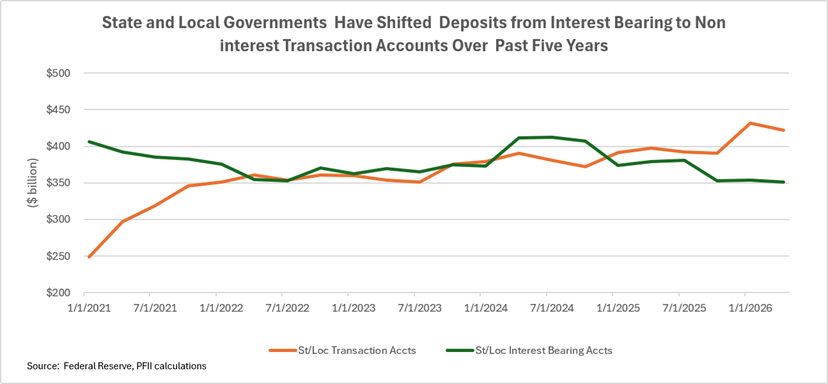
Payment technology has advanced in this period, speeding the velocity of payments and in theory at least reducing the costs and amount of float needed to support payments. But growth of transaction accounts does not reflect this, because banks have increasingly sold transaction account minimums or target balance accounts to replace direct billing of banks fees.
From a bank’s perspective transaction accounts are sticky deposits, unlike interest bearing deposits which have to be renewed when they mature and can easily be moved to another investment vehicle by the public funds depositor.
Banks like sticky deposits so the shift to transaction accounts makes good business sense for them, but this product has unique challenges because the value/opportunity cost changes regularly and consumers (governments in this case) are often slow to react to changes in value. Earnings credit rates to not seem to adjust quickly to market based interest rate changes and the calculation of interest equivalent is complex.
The PFII CD Indices
The Public Funds Investment Institute began compiling indices of rates offered by banks for collateralized deposits across the nation two years ago. These indices, updated weekly, rely on actual bank bids collected by 12 states that bid out CDs of various maturities on a regular basis. The indices are designed to provide a “real world” measure of levels banks offer for collateralized deposits and can offer a window into an otherwise opaque market.
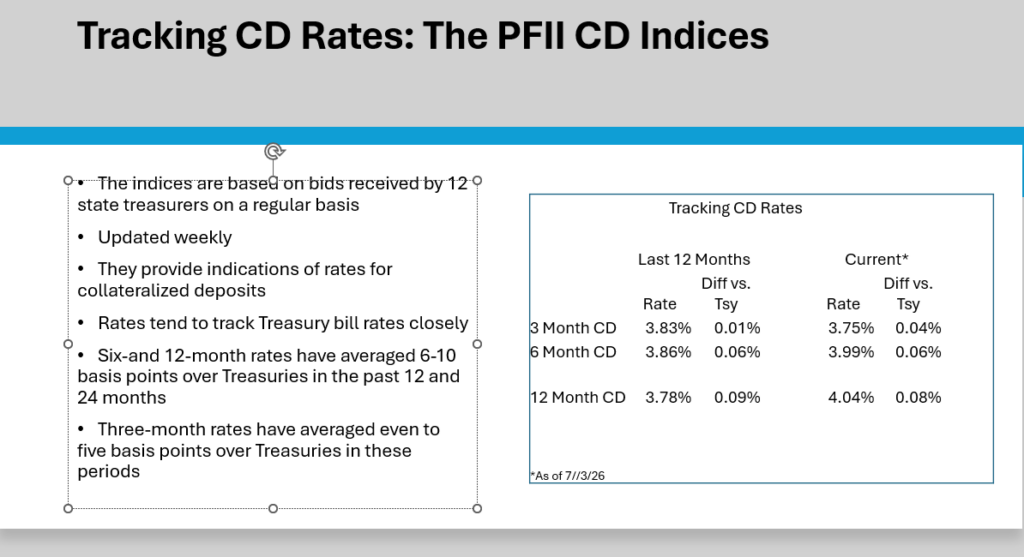
While individual banks may offer rates that are higher or lower than the averages, tracking the overall levels nationally provides a measure of how competitive banks are. The data provides insights into two questions: 1) what the rate trend is nationally for collateralized deposits vs. other permitted investments and 2) how competitive are specific bank offerings vs. the average national rate.
CD indices are an essential tool for public funds investors, available on our website at https://pubfunds.org/dashboard/.
Generally, banks have offered rates that track yields on Treasury bills closely. Over the past two years the average spread has been stable, though it has widened by about four basis points for three-month and 12-month CDs in the past three months, indicating an effort by banks to improve their competitive position in the market.
Legislation to Advantage Deposits
In addition to pushing this shift, banks in a number of states have sought legislation to limit the competition offered by LGIPs. In 2024 New Hampshire considered legislation that would require the state’s LGIP to invest or deposit within the state. A legislative proposal considered in Nebraska would have put “guardrails” around the operation of the state’s pools, limiting their activities. Texas considered bills last year to require LGIPs to invest a portion of their assets in state banks and forbid the pools from paying sponsorship fees. Legislation considered in Iowa earlier this year would have limited the use of the state’s LGIPs by local governments. It failed when the legislature adjourned without taking final action.